What are five ways to fold an infinity cube?
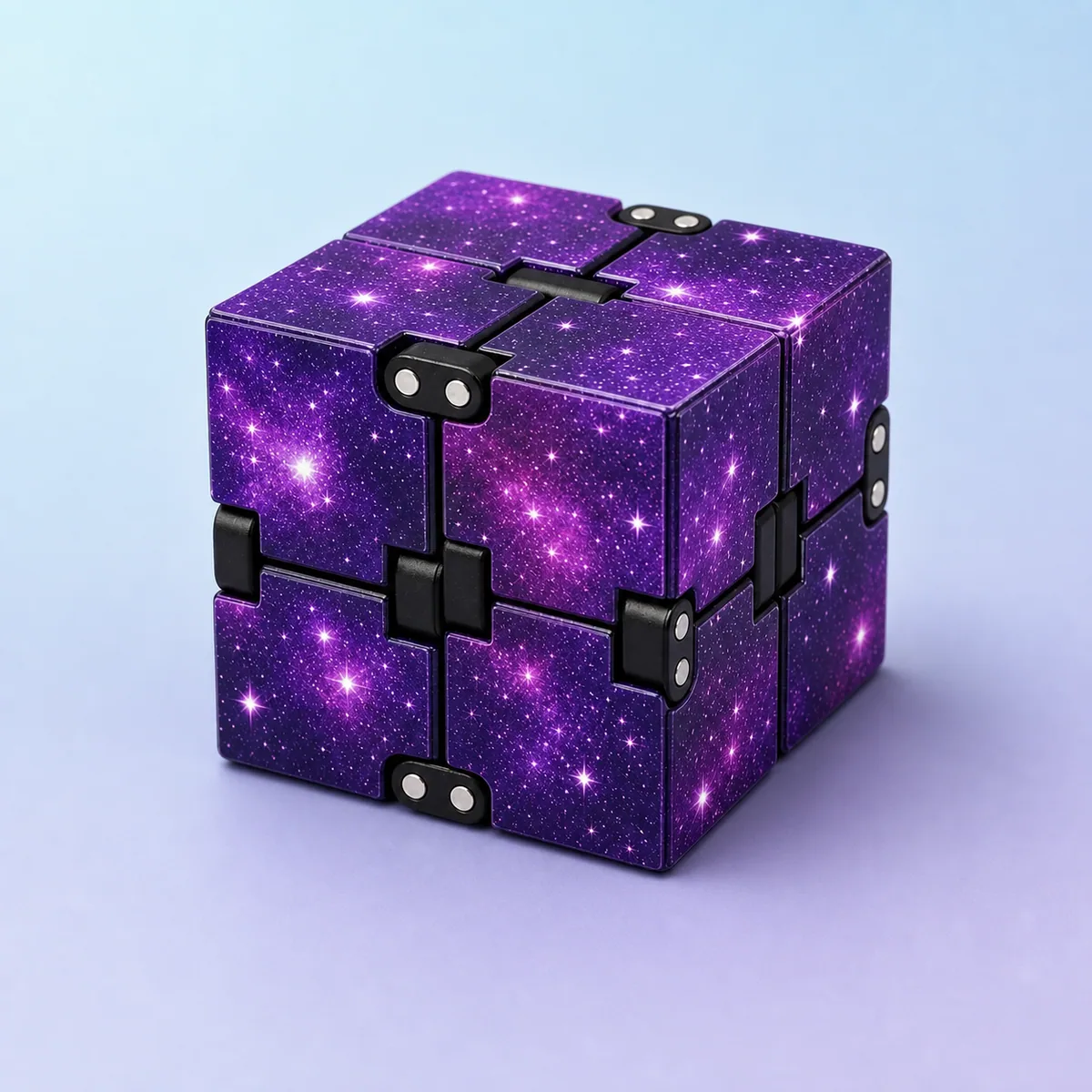
An infinity cube folds along eight small blocks joined by hinges into one continuous loop, and that loop can be pushed forward, backward, sideways, or diagonally, which gives you four real directions to work with and a fifth move that strings them together into a longer sequence. Nobody has published an official list of infinity cube tricks the way skaters name a kickflip. What follows is our own way of grouping the cube’s real folding directions into five things worth practicing, not a set of moves printed on any box.
Most people learn the cube as one flick, in one direction, and stop there. Once you understand the mechanism underneath, the extra four folds are almost free. Same hinges, same thumb, just a different push.
What is actually happening inside the hinges?
Eight cubes are arranged in a 2x2x2 block and connected edge to edge by hinges, so folding one cube frees the next one in line. There is no first cube and no last one. Push any face over and the fold travels through the loop, cube by cube, in whichever direction your thumb sends it.
That loop is also why the toy never locks into a finished shape. A classic Rubik’s Cube has a solved state; an infinity cube does not. Fold it and a new pair of faces comes to the top, and another hinge is ready to go. The hinge count is not the same across every cube on the market either. Some plastic versions use eight molded living hinges, one per block edge, while at least one precision metal design (Fidget House’s titanium Infinity MiNi Cube) gets by on six discrete pin hinges instead. If you see a listing claiming a fixed spec like eight cubes and twelve hinges, treat it as marketing shorthand rather than a documented standard, because the cubes we could check land at six or eight, never twelve.
Why does the loop feel like it never ends?
The endless feeling is real, but the shape itself is not infinite. Wikipedia’s entry on the infinity cube notes that the classic design actually cycles through six total configurations, closer kin to a 2x2x2 Rubik’s Cube with a different folding mechanism than to a puzzle with unlimited states. What feels endless is the motion, not the geometry: you can keep folding the same six shapes forward or backward for as long as you want, and the hand never has to stop to reset.
The folding action is close cousins with a kaleidocycle, a ring of tetrahedra that twists continuously around its own axis, a shape the design world calls a flextangle. Doris Schattschneider and Wallace Walker popularized kaleidocycles in a 1977 book pairing them with M.C. Escher’s tessellation patterns, and that paper-craft lineage is part of where the endless-fold family of toys comes from. The closer, more direct ancestor is the Yoshimoto Cube, a folding and dissection puzzle invented by Naoki Yoshimoto in 1971 and first exhibited in 1972: eight interconnected cubes that fold or unfold indefinitely, the same way a modern infinity cube does, and a puzzle serious enough that Yoshimoto Cube No. 1 entered the Museum of Modern Art’s permanent collection in 1982.
Five folds to try with one hand
- The straight loop. Hold the cube with a hinge line across the middle, push the top half away with your thumb, let it settle flat, and push again in the same spot. This is the fold most people learn first, and the base move the other four build on.
- The reverse. Push toward yourself instead of away. The cube folds back through the same shapes in the opposite order, and it is worth practicing on its own because your thumb has to unlearn the one direction it just got comfortable with.
- The sideways turn. Rotate the cube ninety degrees in your palm before you push, so the fold runs left to right instead of top to bottom. The hinges do not care which way you turn the cube first, so this costs nothing but a wrist twist.
- The diagonal twist. Push from a corner rather than a flat edge. The fold still travels the loop, but the shape changes at an angle instead of straight across, and it looks the most different from the outside of any of the five.
- The free-spin. Once the first four feel automatic, chain them without stopping to look: straight, reverse, sideways, diagonal, straight again, in any order your thumb picks. This is less a single fold than a habit, the same way a fidget spinner user stops thinking about which finger goes where.
What should you look for in the material and hinges?
The bodies come in roughly three tiers. Budget cubes run about five dollars in ABS-style plastic with molded, one-piece living hinges, the kind that flex because the plastic itself is thin at the fold line. Mid-range cubes, ten to fifteen dollars, often add a rubber coating over the same plastic core for a softer grip and a quieter click. Precision versions, twenty dollars and up, are CNC-machined from metal such as titanium or zirconium, with a handful of discrete pin or sprig hinges doing the work instead of molded plastic.
Magnets are not a given. At least one confirmed metal design skips them entirely, relying on the hinge geometry alone to hold each fold in place, with the snap sound coming from metal meeting metal rather than a magnetic catch. Check the specific listing rather than assuming every infinity cube on a shelf works the same way underneath.
Budget, mid-range, or precision: how they compare
| Tier | Typical material | Hinge type | Rough price | Feel |
|---|---|---|---|---|
| Budget | ABS-style plastic | Molded living hinges | About $5 | Light, a bit hollow-sounding |
| Mid-range | Rubber-coated plastic | Molded living hinges | $10 to $15 | Softer grip, quieter click |
| Precision | Titanium or zirconium | 6 to 8 discrete pin hinges | $20 and up | Heavier, a crisp metal snap |
Our Infinity Flip Cube sits at the mid-range end: ABS blocks on fabric-tape hinges, light enough to forget in a pocket and sturdy enough for the straight loop, the reverse, and the sideways turn without complaint.
Which fold should you start with?
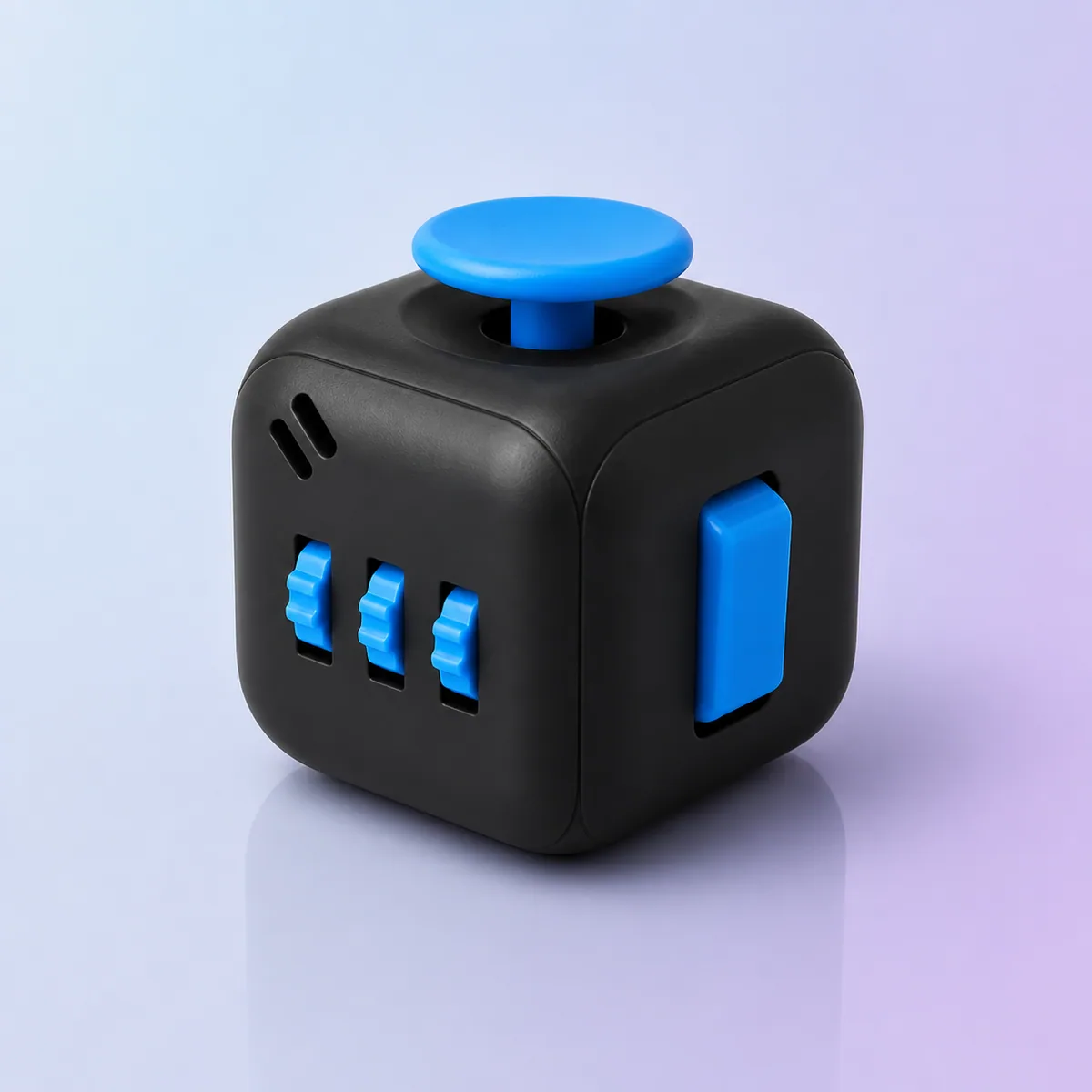
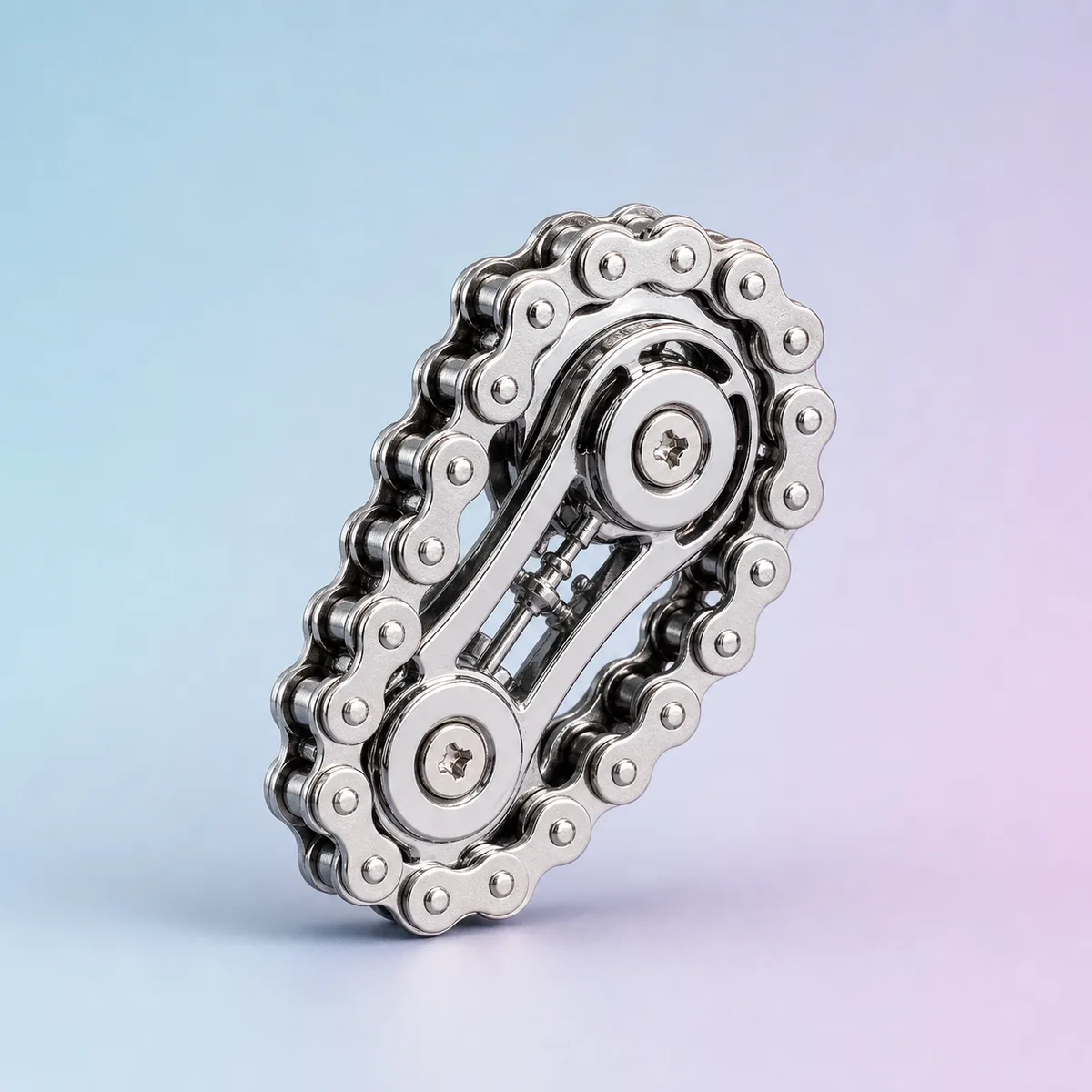
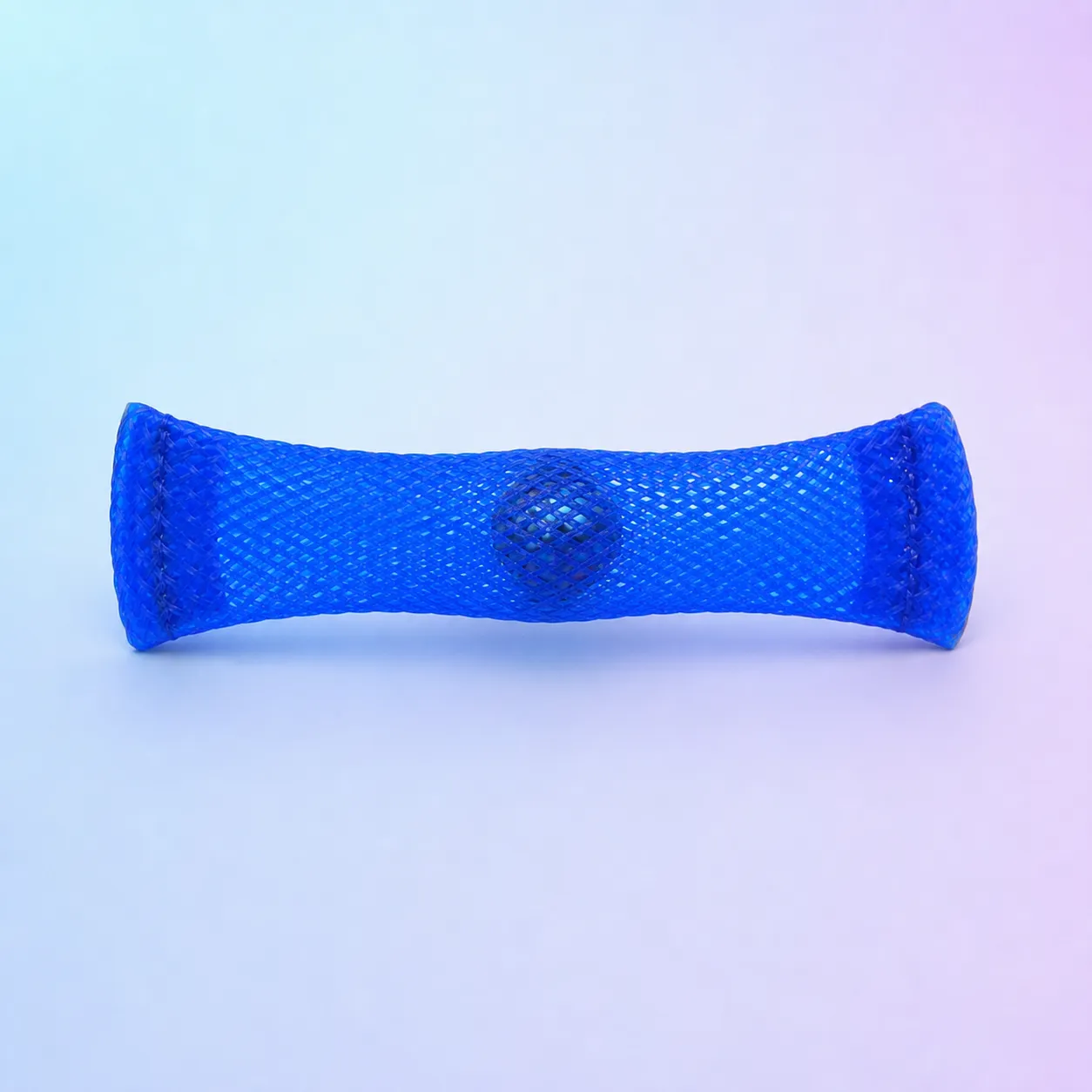
Start with the straight loop until your thumb finds the hinge without looking, then add the reverse the same day, since the two share the same grip. The sideways turn and the diagonal twist are worth a separate session each, because your hand has to unlearn where it expects the next hinge to be. If a single loop starts to feel like the only trick in the box, the Click-Cube Focus Fidget gives your fingers six different small inputs instead of one motion, and the Roll & Flip Chain Fidget or the Roll & Squeeze Mesh Marble Fidget both roll rather than fold, which is a genuinely different feel in the hand. Calm in the palm of your hand, one fold at a time.
Sources & further reading
We reference trusted organizations by name. This article is informational and not a substitute for professional medical advice.
- Wikipedia: Describes the classic infinity cube as cycling through six total configurations and documents the related Yoshimoto Cube, an eight-cube folding and dissection puzzle invented in 1971 that entered the Museum of Modern Art's collection in 1982.
- 3D Print Smiths: Explains the infinity cube's hinge mechanism, how folding one cube frees the next in the loop, and its kinship with the kaleidocycle, a continuously twisting ring shape.
- Fidget House: Documents a precision metal infinity cube built from eight cubes and six discrete pin hinges with no magnets, showing that hinge count and hardware vary by product.
- Hope 4 Hurting Kids: Notes that infinity cubes are sold across a range of materials and price tiers, from inexpensive plastic to precision metal versions.
Frequently asked questions
How many hinges does an infinity cube have?
It depends on the cube. Plastic versions typically use eight molded living hinges, one at each block edge, while at least one precision metal design uses just six discrete pin hinges instead. A claimed spec of exactly twelve hinges is not something we could confirm on any cube we checked, so treat that number as marketing shorthand rather than a fixed standard.
Does an infinity cube ever run out of folds?
No, in the sense that it never reaches a solved or finished shape the way a Rubik's Cube does. The classic design does cycle through six total configurations, so the motion feels endless while the underlying geometry is a fixed loop, and you can keep folding forward or backward through those six shapes indefinitely.
Are the five folding patterns an official trick list?
No. There is no published, industry-standard set of named infinity cube patterns, and any five-pattern breakdown, including ours, is an organizing device built from the cube's real folding directions rather than a documented convention. What is genuinely documented is that the loop folds forward, backward, sideways, and diagonally.
Do all infinity cubes use magnets?
No. At least one confirmed precision metal design has no magnets at all and relies entirely on the hinge geometry to hold each folded position, with the snap sound coming from metal meeting metal. Check the specific product rather than assuming every infinity cube works the same way underneath.
What is the difference between an infinity cube and a Yoshimoto Cube?
A Yoshimoto Cube is the older, documented mathematical puzzle the modern infinity cube resembles: eight interconnected cubes invented by Naoki Yoshimoto in 1971 that fold or unfold indefinitely and can also be split apart into two stellated rhombic dodecahedra. A modern fidget infinity cube shares the same eight-cube folding idea in a simpler toy built for pocket use rather than for the puzzle's original geometric demonstration.
What material should I look for in an infinity cube?
It depends on how you plan to use it. Budget ABS plastic with molded hinges is light and inexpensive, around five dollars, while a precision-machined titanium or zirconium cube runs twenty dollars and up and holds a crisp fold with discrete pin hinges. A mid-range rubber-coated plastic cube, like our Infinity Flip Cube, sits in between: sturdy enough for daily folding with a quieter click than bare plastic.