What age is each fidget toy for?
It depends on how the object is actually built, not on which family of fidget it belongs to. A single molded squishy, a hinged folding cube, a silicone push-pop board, and a tub of putty all fidget differently, and they are all built differently too, which is exactly why they do not all carry the same age number. The label is a safety designation, tied to real physical features, not a rating of how mature or advanced a toy is.
We would rather explain what actually drives that number than let you guess from the shelf. Here is the reasoning behind an age label, and how it plays out across a squishy, a cube, a push-pop board, and putty specifically.
Why do age labels exist at all?
Because they encode a real, tested safety judgment. The American Academy of Pediatrics puts it plainly: age guidelines on toy packages reflect safety, based on any possible choking hazard as well as a child’s physical and mental abilities at that age. The behavioral reason behind the youngest cutoff is specific and well documented: infants and toddlers explore the world by putting things in their mouths, which is exactly how a small or detachable piece ends up somewhere it should not be.
That is also why the label is not really about whether a child is “smart enough” for a toy, and treating it that way misses the point. A precocious four-year-old and a cautious four-year-old face the same physical risk from the same small part; the label reflects the object, not the child’s temperament.
It is a narrower promise than it sounds, too. An age number tells you a product cleared a specific set of physical tests for that age band. It does not tell you whether a child will enjoy the toy, find it too easy, or find it frustrating, and it says nothing at all about anything not covered by those specific tests. Reading a label as a full safety guarantee, rather than as the answer to one well-defined question, is where most of the confusion starts.
The three-tier structure behind every label
Most age numbers on a fidget toy trace back to a specific federal structure. Anything intended for children under 3 cannot legally contain a small part at all, full stop, no warning label allowed as a substitute. Toys for children 3 to 6 that do contain small parts have to carry an exact federal choking-hazard warning instead. Small balls, marbles, and latex balloons get a separate, wider band that runs to age 8, and the AAP corroborates that cutoff independently, noting that balloons specifically pose a choking risk to children up to that age.
Once you know that structure, a lot of otherwise-confusing labels make sense. An 8+ number on something small and round is usually about that ball-marble-balloon band, not a sign the product is somehow more dangerous overall than a 3+ toy; it is a different specific test.
How does this play out across different fidget types?
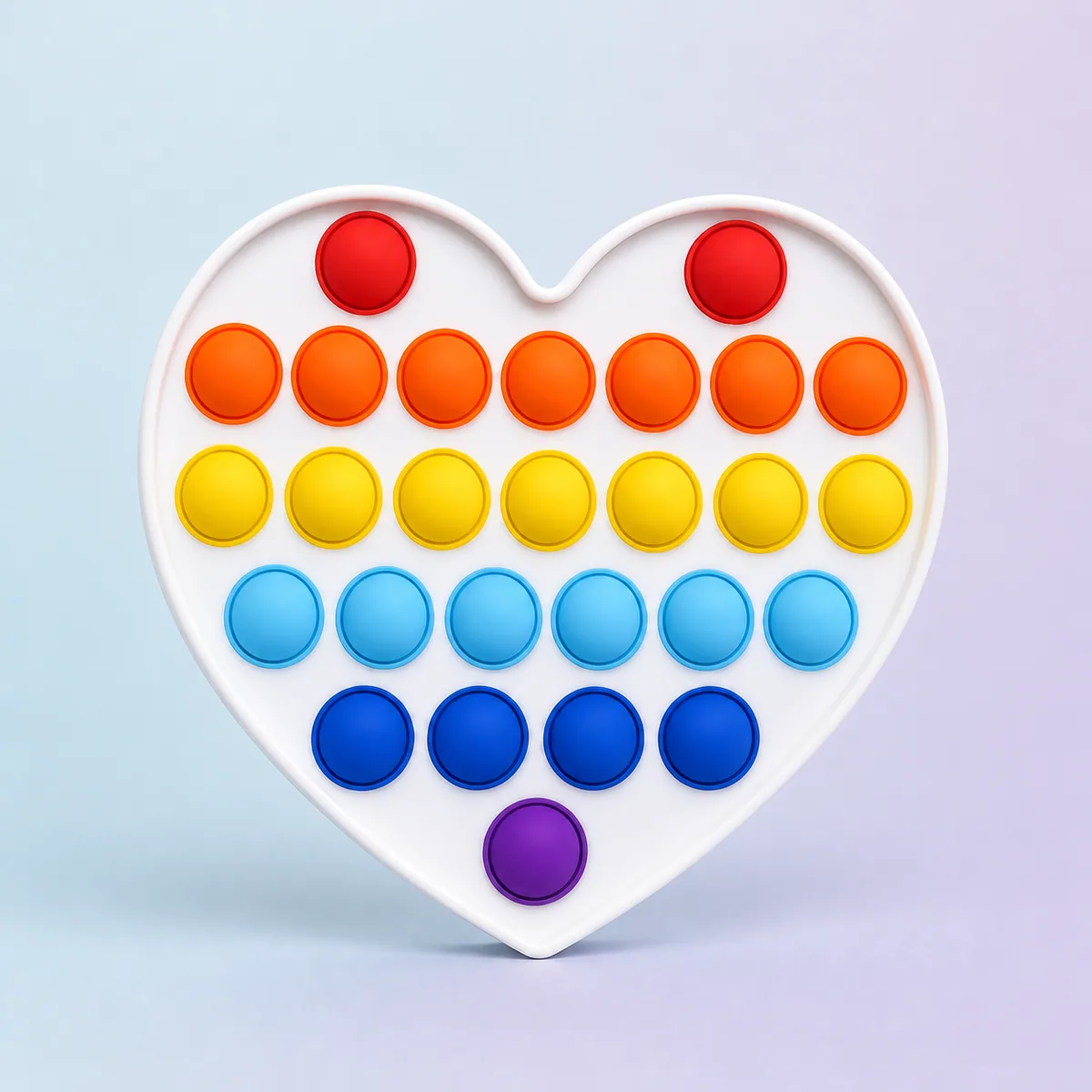
Start with the shape. Hush Pop Push-Pop Sensory Board and Peachy Slow-Rise Squishy are both single molded pieces: nothing detaches, and there is no small part to test against the cylinder in the first place, which is the physical reason both fall toward the lower end of the age scale for their category. Infinity Flip Cube is a hinged, connected mechanism rather than loose blocks, so its blocks are not designed to separate the way a set of loose pieces would be, though any hinge or fastening is still worth a periodic look on a toy that gets handled hard every day.
Calm Putty is the one that behaves differently, and it is worth being direct about why. A puttable, moldable texture is built to be pulled, stretched, and pinched into pieces, which makes it easier to bite off and swallow a piece of than a solid molded shape is. That single construction fact is why putty and dough as a category commonly carry a higher baseline age recommendation than a plain squishy does, and why specialty putty with small embedded pieces, like magnetic mix-ins, tends to run higher still. Check the specific number on each product’s own page; construction logic explains the pattern, but the printed number is the one that actually governs a given box.
Is the CPSC’s age guidance itself a law?
Not exactly, and the distinction matters. The CPSC’s Age Determination Guidelines, in effect since 2020, grade a product against a three-factor model: a child’s skills, play behavior, and interests at a given age. That framework shapes how manufacturers and retailers assign an age number, but the guidelines themselves are staff guidance, not a standalone regulation with its own force of law.
The actual legal backbone sits elsewhere: the small-parts ban and 3-to-6 warning label, the magnet safety rule, and ASTM F963, the mandatory toy safety standard covering anything made or marketed as a plaything for children under 14. The age number you see is usually the product of all of these working together, not any single rule acting alone.
A quick way to read a label
| What you see on the label | What it usually reflects |
|---|---|
| 3+ on a solid molded toy | No small parts as manufactured; passed the small-parts cylinder test |
| 3-6 warning with small parts | Contains a small part, so a specific federal choking warning is required |
| 8+ on something small and round | The separate balls, marbles, and balloons band, not a general danger signal |
| 8+ or higher on putty, dough, or a kit | Reflects a mouthable texture or small mix-in pieces, both choking-relevant |
So the honest reading habit is this: look at what the toy is actually made of and shaped like, then check the specific number, and treat the number as information about the object rather than a judgment on the child holding it. Calm in the palm of your hand, at whatever age that hand happens to be.
Sources & further reading
We reference trusted organizations by name. This article is informational and not a substitute for professional medical advice.
- American Academy of Pediatrics: Publishes consumer guidance through HealthyChildren.org stating that age recommendations on toy packages reflect safety, based on choking hazard and a child's physical and mental abilities, not difficulty.
- U.S. Consumer Product Safety Commission: Enforces the small-parts ban for children under 3, the required warning label for ages 3 to 6, the wider under-8 band for balls, marbles, and balloons, and the mandatory ASTM F963 toy standard.
- UL Solutions: Reports on the CPSC's 2020 Age Determination Guidelines, which grade a toy against a child's skills, play behavior, and interests rather than a single fixed cutoff.
- ASTM International: Publishes ASTM F963, the mandatory US toy safety standard covering any object designed, made, or marketed as a plaything for children under 14.
Frequently asked questions
What age is each fidget toy actually for?
It depends on the object's construction, not on what kind of fidget it is in general. A single molded piece, like a squishy or a silicone push-pop board, tends to sit at the lower end of the age scale. Putty, dough, and anything with small mix-in pieces tends to run higher, and the exact number for any specific product is printed on its own page.
Why do fidget toys have age labels at all?
Because the label is a safety designation, not a difficulty rating. The American Academy of Pediatrics advises parents to follow the age recommendations on toy packages because those numbers are based on choking hazard and a child's physical and mental abilities at that age, particularly the tendency of young children to mouth what they are holding.
Is a squishy generally safer for young kids than putty or dough?
A single molded squishy has fewer choking-relevant features than a puttable, moldable texture, since there is nothing loose to detach and nothing designed to be pulled into small pieces. That is a construction difference, not a guarantee, so the specific age number on each product still matters more than the general type.
Why does thinking putty sometimes carry a higher age recommendation than a squishy?
A moldable, stretchable texture is easier to bite off and swallow small amounts of than a solid molded shape, which is the physical reasoning behind a higher age number. At least one major thinking-putty brand sets its plain putty around age 3 and moves specialty variants with embedded pieces higher still, which lines up with the small-parts and magnet concerns regulators track separately.
Is the CPSC's age guidance a legal requirement?
Not directly. The CPSC's Age Determination Guidelines are a staff framework used to grade a product against a child's skills, play behavior, and interests, and they inform how products get labeled. The actual legal requirements sit in separate regulations: the small-parts ban and warning-label rule, the magnet safety rule, and the general toy safety standard.
Should I trust the age label over my own judgment of my child?
Use both. The label reflects tested physical hazards like choking and small parts, which a parent cannot see just by looking at a product. Your own read of your child, whether they still mouth objects or handle small pieces carefully, is the other half, and the safer choice is whichever of the two is more cautious.